AI Research
Automate tasks, not jobs
The AI opportunity for Scotland’s public services. Independent analysis identifying the highest value public sector workflows for AI driven productivity gains.
Download full report (PDF 2.9mb)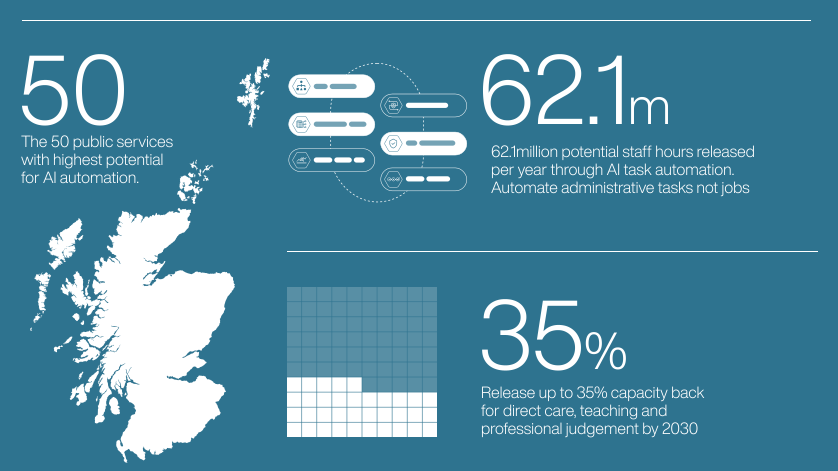
Executive summary
Scotland’s public services face a defining moment. The 2026/27 Budget and multiyear Spending Review highlight the central challenge of the decade ahead: sustaining service quality in the face of demographic pressure and constrained resources. To meet this, the Scottish Government has mandated a significant focus on efficiency and reform across the entire public sector.
This is not simply a funding problem; it is also a capacity problem. Without releasing frontline time from administrative and coordination overhead, services will struggle to sustain access, quality and equity, particularly in health and social care, education and local government.
This paper sets out the case for adopting AI-enabled service redesign in Scottish public services to reduce administrative burden, improve responsiveness and protect frontline capacity guided by a clear principle throughout - automate tasks, not jobs. The objective is workforce enablement and better outcomes resulting in higher throughput, shorter backlogs, faster response times and more staff time for direct public value work.
What we analysed
We assessed 50 high-volume public sector services across Scotland with the strongest potential to release staff time through credible AI use cases, spanning:
- NHS Scotland
- Education
- Scotland’s local authorities
- Police Scotland and justice-adjacent administration
- Other public bodies, including high-volume transactional services
Across these 50 services, we estimate a baseline of ~178 million staff hours per year, distributed approximately as follows:
Our modelling focuses on capacity release (time back) rather than assuming immediate cash savings. In practice, AI benefits in public services will typically show up first as improved throughput, reduced backlogs, and increased time for higher value work. Budget impacts depend on later workforce and service design choices.
Up to 62.1 million staff hours per year released by 2030Low, moderate and optimistic adoption and impact scenarios
Capacity release to absorb demand pressures and improve service% of staff baseline hours per year
Annual time back for public sector workers by 2030Potential sector-level implications
50 high-volume services prioritised for AI-enabled service reformThe route to scale is to build reusable and configurable AI components

5 repeatable service patternsOperational workflows cluster into a small number of repeatable patterns
Data sovereignty is a requirementHalf of the top 50 services would likely require a private deployment
The paper also shows that demand and administrative load are set to rise over the next few years without reform. AI enabled redesign can do more than marginally improve today’s position: it can help offset projected workload growth if implemented at scale with the right operating model and controls.
The opportunity: repeatable service patterns
While Scottish public services are diverse in mission, their operational workflows cluster into a small number of repeatable patterns. Across the fifty services analysed, these can be grouped as:
Service pattern distribution across the 50 workflows
Document management represents 51% of total hours
Scotland does not need to build fifty bespoke solutions. The fastest, safest route to scale is to build reusable and configurable AI components aligned to these common patterns and integrate them into existing systems of record.
Automate tasks, not jobs
The paper is explicit that the aim is workforce enablement, not indiscriminate headcount reduction. In a system already under workforce strain, the intended outcomes are:
- More time for direct care, teaching and professional judgement
- Shorter waiting times and faster decisions by increasing throughput
- Improved consistency and quality in documentation, correspondence and case preparation
- Better staff experience by reducing duplicative admin work
Delivering this credibly requires making the approach operational through workforce engagement in the design of new AI services, training on how to adopt new workflows and ongoing monitoring and continual improvement. This will ensure that time saved translates into better outcomes and is not simply absorbed again by unmanaged demand.
Infrastructure and data sovereignty
The paper compares infrastructure models for hosting AI services, including UK based cloud services appropriate for many transactional and administrative workloads, and private / sovereign environments suited to higher sensitivity contexts such as clinical and criminal justice data, where additional privacy, security and access controls are required. The analysis indicates that around half of the top 50 services assessed would likely require a private deployment model based on data sensitivity and risk.
AI infrastructure requirements by service type
Call to Action
To turn opportunity into outcomes by 2030, this paper argues Scotland should:
- 1Prioritise high-volume, lower-risk workflows first.Demonstrate value quickly and build institutional capability.
- 2Build shared, reusable AI components.Mapped to common service patterns, avoiding duplication across NHS boards, councils and public-sector bodies
- 3Establish robust governance and assurance.A prerequisite for scale: clear accountability, audit trails, cyber controls, testing and monitoring and defined human oversight which is consistent with Scotland’s commitment to trustworthy, ethical and inclusive AI.
- 4Adopt a mixed infrastructure strategy.Combining UK public cloud for suitable workloads with private AI infrastructure for high sensitivity services.
- 5Treat workforce enablement as a core deliverable.With training, role redesign, and staff engagement throughout.
Scotland cannot bridge its structural capacity gap through incremental digitisation alone. This analysis demonstrates that if implemented safely, transparently and in partnership with the workforce, AI has the credible potential to release tens of millions of staff hours from current administrative burdens by 2030 and help contribute to meeting the £1.5bn of efficiency savings targeted over the Spending Review period.
Download the AI White paper
Learn about the AI opportunity for Scotland’s public services