Doing nothing was the rational choice. AI has changed the arithmetic on legacy systems

Over 25 years of working with Scotland’s public sector, we’ve heard many versions of the same frustration. People can see how a service could improve. They know where staff are duplicating work, where information gets stuck and which processes create unnecessary delays. Making those improvements often means changing an underlying system and that is where the business case becomes difficult.
These applications can hold decades of policy, operational knowledge and connections to other services. They often perform essential functions reliably day in day out. Replacing them takes money, scarce expertise and a careful transition, while the existing service continues to operate every day.

Faced with a substantial upfront investment and a return that might take ten years to arrive, keeping the existing system running for another year has often been a reasonable decision. Repeated across the public sector, those decisions leave more of the technology estate ageing, consuming the resources needed to improve it.
Our latest research, Breaking the Legacy Trap: How AI changes the economics of modernising Scotland's public services, looks at how that calculation is changing.
The systems behind better services
Earlier this year, we published Automate Tasks, Not Jobs. That research examined 50 high-volume public services across health, education, local government, policing and other public bodies. We estimated a baseline of around 178 million staff hours a year across those services and explored how much capacity AI-enabled service redesign could release.
Our moderate scenario identified the potential to release around 36 million hours annually. The intended benefit was more time for care, teaching, casework and professional judgement, alongside shorter backlogs and faster responses. Realising that benefit requires changes to how services work, with staff involved in designing and adopting those changes.
The new paper follows that work into the technology underneath those services. Some useful automation can be introduced around existing applications. More substantial improvements can depend on changing core workflow systems that make information difficult to share or require people to move it manually between processes.
We wanted to understand whether AI could make that underlying change more affordable.
How AI changes the work of modernisation
The research brings together our own delivery measurements, published UK Government evidence on legacy operating costs and Scottish public sector spending data.
On one UK public sector programme, we measured a 40% reduction in effort against conventional delivery baseline across Discovery and Alpha. Across our wider AI-assisted legacy app transformation work, observed savings have ranged from 15% to 60%, depending on the system. Access to source code, the complexity of integrations, data quality and the rules embedded in an application all affect what is achievable. Further measurement through complete replacements will help establish how those gains carry through into live services.
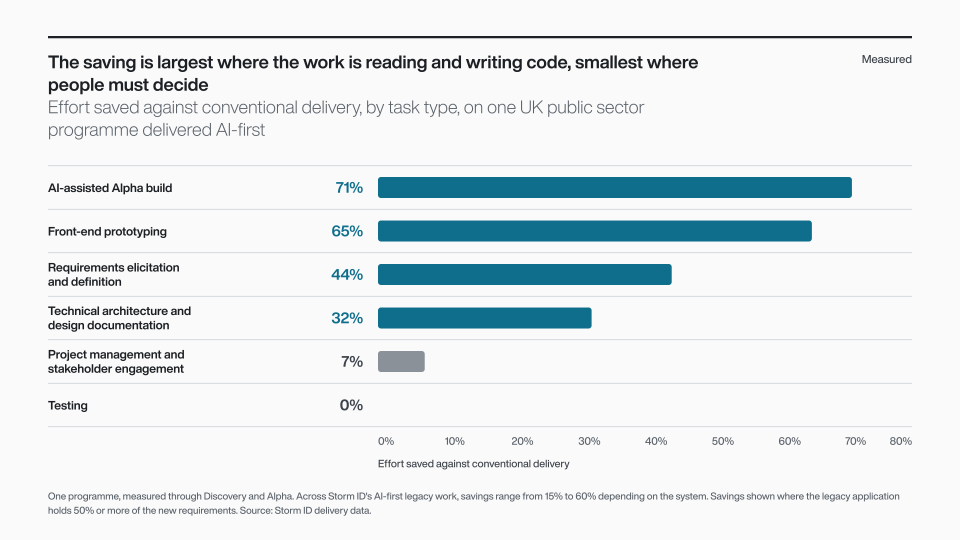
Storm ID’s wider AI-first legacy modernisation experience suggests that savings vary considerably between systems, with an observed range of approximately 15% to 60% depending on factors such as source-code availability, architecture, integrations, data quality, technology and governance requirements.
Much of the opportunity comes from understanding the old system.
Before a team can safely replace an application, it must understand and document the rules, exceptions and dependencies accumulated over years. Relevant knowledge may sit across code, database structures, spreadsheets, support tickets and the experience of long-serving staff.
AI can help engineers assemble and examine that evidence much faster. Service specialists can then challenge the findings, resolve gaps and decide what features and functions should be preserved, improved or retired. Validated requirements provide a stronger basis for prototypes, replacement code and tests.
Experienced people remain responsible for those decisions. Delivery budgets still need to account for governance, security, accessibility, testing and assurance time. Indeed, faster engineering increases the importance of having clear acceptance criteria and deterministic checks that can establish whether the result is correct.
A business case worth revisiting
The effect on an individual business case can be substantial.
The paper illustrates an application costing £1 million a year to maintain, with a conventional rebuild cost of £3 million. Using the government benchmark for lower operating costs in modern systems , the replacement would save around £286,000 annually. The conventional rebuild therefore takes about 10.5 years to pay for itself.
Apply the paper’s central assumption of 40% less delivery effort and the illustrative rebuild cost falls to £1.8 million. Payback comes down to around 6.3 years. Both calculations count only lower running costs; improvements to the service could create further value.
That is a meaningful change for someone trying to secure investment. A business case that was difficult to justify deserves another look.
What this could mean for Scotland
At Scotland's scale, the potential becomes significant.
Applying a UK Government legacy spending benchmark to published Scottish ICT expenditure gives an estimated annual legacy running cost of around £930 million. Scotland does not yet have a comprehensive shared inventory against which to test that estimate, so establishing a better picture of the estate is one of our recommendations.
We modelled an illustrative four-year scenario in which the proportion of the legacy estate modernised rises from 10% in the first year to 40% by the fourth. Under the central assumptions, around £291 million in running costs could be avoided over those four years, reaching approximately £120 million annually by Year 4.
Those figures represent expenditure avoided compared with continuing to run the legacy estate, before deducting the investment required for modernisation. Delivery schedules, parallel running and the point at which old contracts can end will affect when benefits arrive. The first wave needs upfront funding.
The same scenario also models additional engineering capacity and around 14.4 million staff hours released annually by Year 4, as services are redesigned around modern systems. These are different forms of value and we report them separately. An hour released becomes useful capacity when an organisation can put it towards work that improves the service.
Connecting system renewal with service reform
For me, this is where the two research papers connect most clearly. Making systems more affordable to change creates opportunities to remove the administrative work identified in our earlier research. The benefits depend on technology renewal and service redesign progressing together.
Scotland's Public Service Reform Strategy sets out ambitions for prevention, joined-up services and greater efficiency. Delivering those ambitions involves practical questions about how information moves, how organisations work together and how staff spend their time.
Legacy modernisation can help create the conditions for that change. Better access to reliable information can support delivery of user centred services that cross organisational boundaries. Removing duplicate entry and unnecessary processing can give staff more time to work with people. Lower operating costs can create room for further improvement.
Storm ID's interest in this comes from the work we have done alongside public bodies across Scotland for 25 years. We understand how much effort goes into keeping essential services running and how difficult it can be to make space for change. We are also seeing a material shift in what our own teams can achieve with AI-assisted analysis and engineering. Publishing the research gives us a way to examine that experience, make the assumptions visible and invite others to test them.
Start with a focused first wave
I think Scotland should begin with a focused first wave of systems, selected against service value, operating costs, risk and feasibility. Build the inventory alongside that work. Establish common assurance standards for AI assisted delivery, involve staff and service users, and measure what changes. Where savings are demonstrated, agree how a share can support the next wave.
That would give Scotland a firmer basis for deciding where to invest and how quickly to expand.
For organisations ready to examine their own position, our legacy system modernisation service provides a practical starting point. We help teams understand what an existing system does, validate its business rules and assess the options for change, using AI-assisted discovery and engineering with human review throughout.
Bring us one system that is holding back a service. We can help you test the assumptions, assess the business case and establish what a credible route to modernisation could look like.