GovCamp Cymru 2026: Great conversations, fresh thinking and a shared ambition for better public services

There is something refreshing about bringing together people who care passionately about improving public services, giving them the space to share ideas, challenge assumptions and learn from one another, and seeing where the conversations lead.
That was very much my experience of GovCamp Cymru in Cardiff on Friday, where Storm ID was delighted to be a sponsor and to take part in what proved to be an inspiring and thought-provoking day.

Held at the Welsh Government offices in Cathays Park, GovCamp Cymru brought together people from across Wales' public sector and digital community, united by a shared ambition to reimagine public services and deliver better outcomes for the people who depend on them.
From the moment we arrived, the welcome was incredibly warm. There was a real sense of enthusiasm, openness and curiosity, and a willingness to share experiences and tackle some of the challenges facing public services.
For me, that is what makes events like GovCamp Cymru so valuable.
The power of the unconference
One of the things I particularly enjoy about GovCamp is its unconference format.
Rather than arriving to a predetermined programme of presentations and keynote speeches, the agenda is created by the people attending. Participants pitch ideas, questions or challenges they want to explore, and the discussions develop from there.
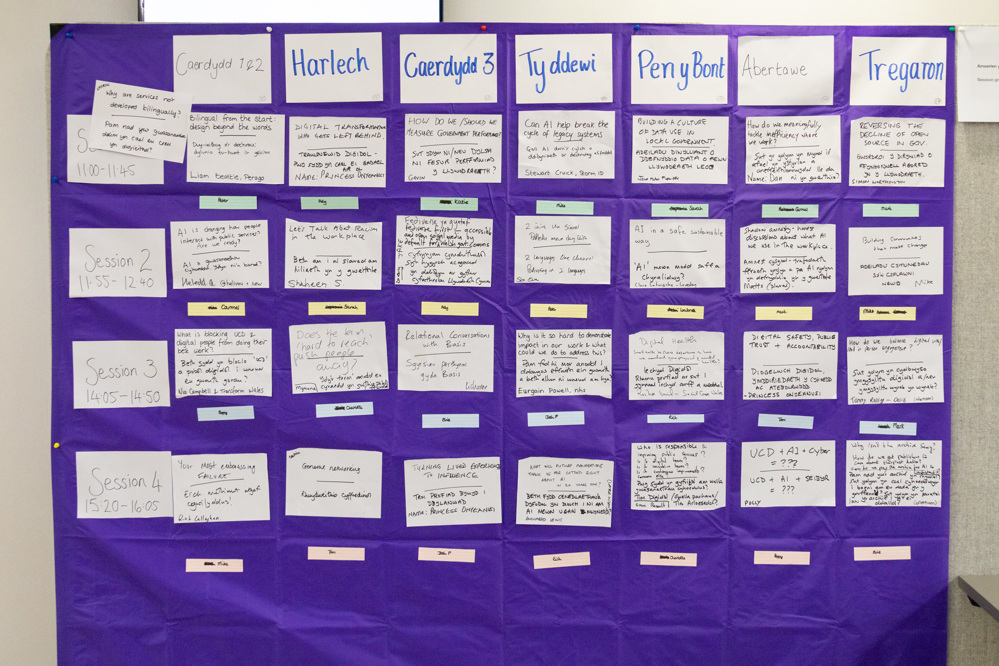
Following the morning's welcome and pitching session, the day unfolded through four rounds of participant-led discussions, with plenty of opportunities for networking and conversations in between.
It is a format that encourages participation rather than passive listening. It creates space for honest conversations, practical experiences and perspectives that might not otherwise find their way onto a traditional conference agenda.
And it works particularly well when discussing public service transformation, where some of the most valuable insights come from the people working directly with the systems, services and organisational challenges we are trying to improve.
What struck me throughout the day was the willingness of people to engage constructively, share what they had learned and explore opportunities to do things differently.
Sharing experiences across Scotland and Wales
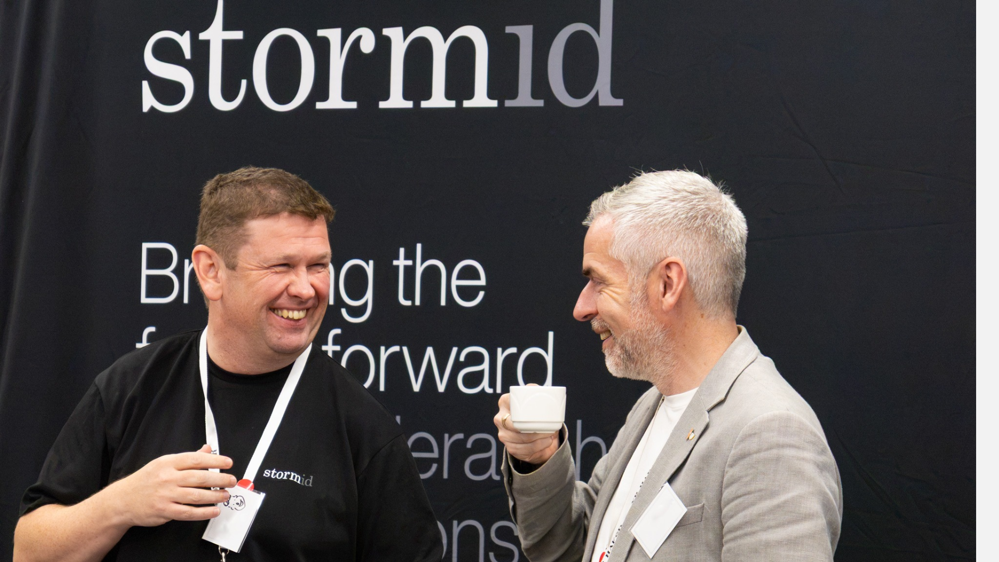
It was also fantastic to see the genuine interest in Storm ID's work and the experience we have built over 25 years of helping public sector organisations modernise services, adopt new technologies and deliver meaningful digital transformation.
Much of that experience has been developed through our work with public sector organisations in Scotland, across government, health, justice and other essential public services.
We had some really encouraging conversations with delegates interested in understanding what has worked in Scotland, what we have learned along the way and how those experiences might be relevant to the opportunities and challenges facing Wales.
Of course, every public service operates within its own context. Wales has its own priorities, structures, communities and requirements, and it is important that digital transformation reflects those differences.
But there is also an enormous amount we can learn from one another. Many of the challenges are shared, whether that is modernising ageing technology, making better use of data, improving accessibility or finding new ways to deliver services with increasingly constrained resources.
It was particularly rewarding to discuss our more recent work in Wales, including the award winning Welsh Elections Information Platform, which we developed for the Democracy and Boundary Commission Cymru (DBCC).
The platform, available through vote.wales and bwrwpleidlais.cymru, provides voters with clear, accessible and trusted information about elections in Wales. Designed as a fully bilingual service from the outset, it demonstrates what can be achieved through close collaboration, user-centred design and a shared commitment to delivering something that genuinely meets people's needs.
It was also lovely to reconnect with our friends at Ateb, the Welsh language specialists we partnered with on the platform. Their expertise and understanding of the linguistic and cultural context were invaluable in helping us deliver a service designed for Wales, rather than simply adapted for it.
Partnerships like this matter enormously, and it was a pleasure to catch up in person.
Can AI break the legacy technology cycle?
I also had the opportunity to host a discussion exploring a question that is increasingly relevant across the public sector: Can AI help break the cycle of legacy technology in Welsh public services?
It is a subject close to our hearts at Storm ID and one we have been exploring extensively through our own research and practical experience of AI-assisted legacy modernisation.
Legacy systems remain a significant challenge for public sector organisations. They can be expensive to maintain, difficult to change and increasingly disconnected from the needs of the people and services they support.
For years, the cost, complexity and risk of replacing these systems have made modernisation difficult to justify. But advances in AI-assisted software engineering are beginning to change that calculation.
The discussion was encouraging, not least because there was clear recognition that legacy technology is a challenge across many parts of the Welsh public sector. There was also growing awareness of how AI can accelerate the analysis, understanding and modernisation of existing systems.
However, what made the session particularly valuable was that the conversation went well beyond the technology itself.
One of the strongest themes was that we must avoid simply recreating yesterday's systems using tomorrow's technology.
AI might make it faster and more affordable to understand and rebuild legacy applications, but that does not mean we should automatically reproduce the same processes, constraints and assumptions.
Instead, modernisation needs to begin with user-centred principles. What services does Wales need today? How should those services work? What can be simplified, improved or fundamentally redesigned?
There was also strong recognition of the importance of open standards and data interoperability. Modernising individual systems will only take us so far if information remains locked within organisational or technical boundaries.
If we want more joined-up public services, we need to create the conditions for data to flow securely and appropriately between organisations.
And while AI offers significant opportunities to accelerate software development, the group was equally clear about the importance of responsible implementation.
Human oversight, robust engineering practices, security, quality assurance and appropriate guardrails must remain central to AI-assisted development. Speed cannot come at the expense of trust, reliability or safety.
An opportunity for Wales to work collectively
Perhaps the most interesting part of our discussion was the consideration of what the Welsh public sector might achieve by approaching some of these challenges collectively.
Several practical ideas emerged.
There was interest in developing shared guidance for the safe and effective use of AI-assisted coding, helping teams understand how to manage risks such as hallucinations, data leakage and code quality.
We also discussed the importance of building capability within public sector development teams. AI-assisted engineering is evolving rapidly, and organisations need opportunities to learn how to use these tools appropriately while continuing to develop and retain their own technical expertise.
Procurement was another important consideration. How can public sector organisations make informed decisions about AI tooling, including the relative merits of open-source and proprietary approaches, without creating a new generation of long-term vendor lock-in?
And how might organisations share their experiences, learn from emerging practice and collaborate on identifying the highest-risk legacy systems where modernisation could deliver the greatest benefit?
These are not questions that any one organisation can answer in isolation.
For me, the discussion highlighted the potential value of shared standards, common guidance, communities of practice and greater collaboration across Welsh public services.
There is an opportunity not simply to accelerate modernisation within individual organisations, but to develop a more coordinated approach that builds capability, reduces duplication and helps the whole sector move forward.
That is an exciting prospect.
Building on the conversations
At Storm ID, we have been exploring how AI changes the economics of legacy modernisation, including through our recent research, Breaking the Legacy Trap.
Our practical work suggests that AI-first approaches can reduce the effort involved in understanding, reconstructing and modernising legacy applications by around 40%.
That has potentially significant implications for public sector organisations that have historically struggled to make the business case for replacing ageing systems.
But one of my biggest takeaways from GovCamp Cymru is that the opportunity is about much more than reducing development costs or delivering technology faster.
It is about creating the capacity to rethink services, improve how organisations work together and deliver better experiences for citizens.
The technology is advancing quickly. The challenge now is ensuring that public sector organisations have the confidence, skills, governance and opportunities for collaboration needed to make the most of it.
That is why conversations like those we had on Friday are so important.
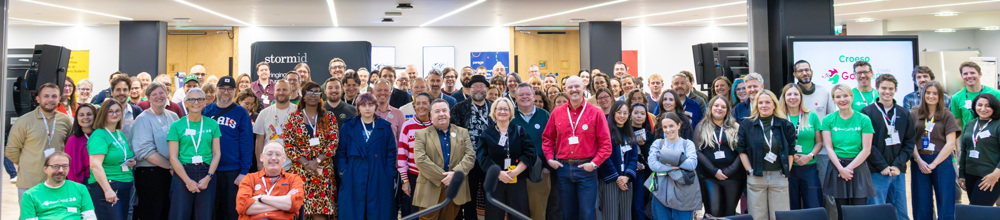
Diolch, GovCamp Cymru!
We left Cardiff feeling energised and encouraged by the enthusiasm, expertise and commitment of the people we met.
There was genuine curiosity about the work we are doing at Storm ID, both in Scotland and increasingly in Wales, and a real appetite to explore how experience and learning can be shared across borders.
It reinforced my belief that some of the most meaningful progress in public service transformation comes from bringing people together, being open about the challenges and working collaboratively towards practical solutions.
A huge thank you to the GovCamp Cymru organisers, the Welsh Government for hosting, everyone who contributed to the discussions, and all those who made us feel so welcome.
We were delighted to support the event and thoroughly enjoyed being part of it.
I am particularly grateful to everyone who joined my session and contributed such thoughtful, constructive ideas. I hope those conversations continue, because there is clearly much more we can explore together.
Diolch yn fawr iawn, GovCamp Cymru. We look forward to continuing the conversation!
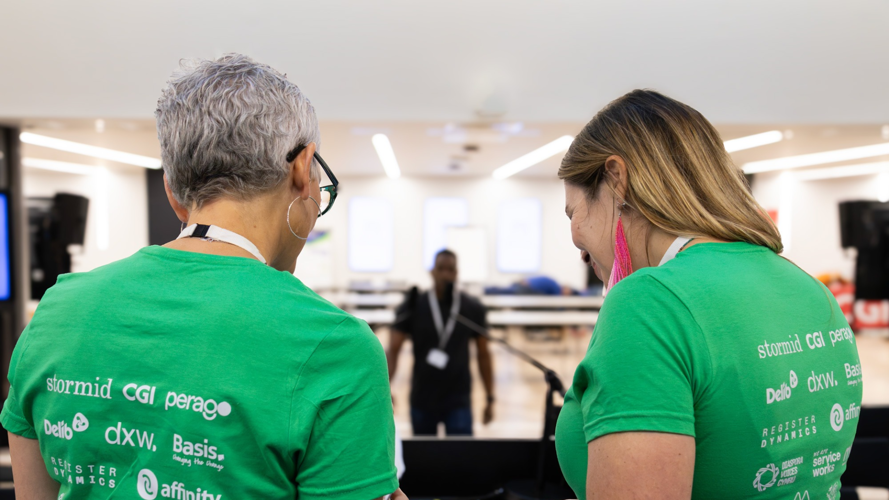
All images copyright Josh Rousen.